
Dr. Sartajvir Singh an accomplished academician and researcher at Indian Institute of Technology (IIT) Ropar, India, specializing in Electronics and Communication Engineering. He is a digital image analyst with expertise in remote sensing and earned his PhD in Electronics & Communication Engineering. He is practicing as Registered Patent (IN/PA 5806), Trade Mark (TMA 34156) and other Intellectual Property (IP) professional. He is also DGCA approved commercial Drone Operator (RPC/34231626V91SD). So far, he has filed 75 innovations/patents at the Indian Patent Office (IPO) with 35 Granted/Awarded. With expertise in the filed of Remote Sensing, Computing Algorithms, and Electronics, he has published 100 in SCI/Scopus Index Journals. An active IEEE member, he engages with IEEE Young Professionals, IEEE GRSS, IEEE Sensors, AGU, EGU, HG, ISTE and ISPRS. His research focuses on Remote Sensing, Automation, AI/ML and Computer Vision. He has served as a keynote speaker and resource person for numerous workshops and webinars. He also edited 2 conference proceedings, 10 books with publishers like Springer, Wiley, De Gruyter, Bentham, Elsevier, CRC, and Apple Academic Press.







Watch this quick video to learn how to set up Zotero.
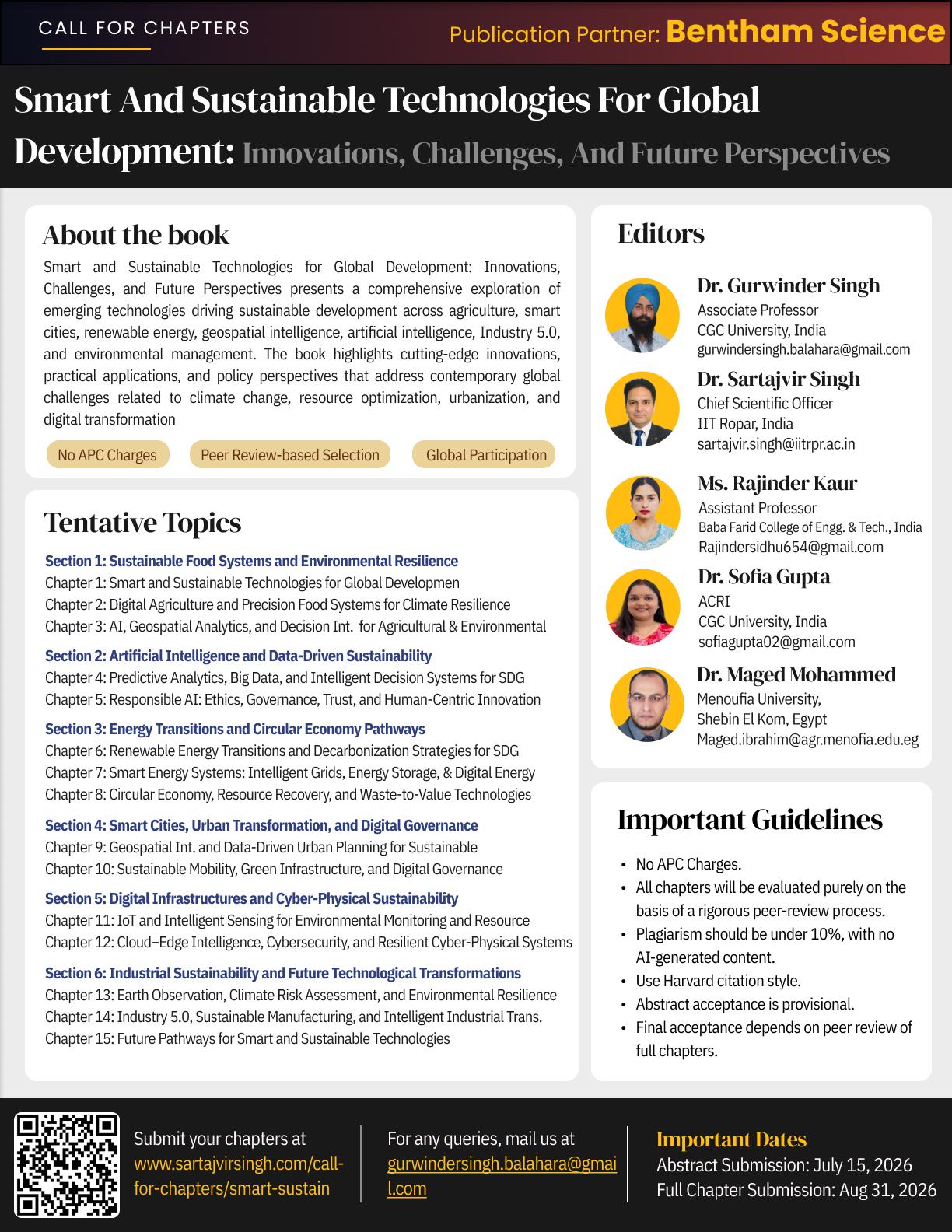
Smart and Sustainable Technologies for Global Development: Innovations, Challenges, and Future Perspectives
Publisher: Bentham Science
Editors: Gurwinder Singh, Sartajvir Singh, Unknown Editor, Unknown Editor, Maged Mohammed
Smart and Sustainable Technologies for Global Development: Innovations, Challenges, and Future Perspectives presents a comprehensive exploration of emerging technologies driving sustainable development across agriculture, smart cities, renewable energy, geospatial intelligence, artificial intelligence, Industry 5.0, and environmental management. The book highlights cutting-edge innovations, practical applications, and policy perspectives that address contemporary global challenges related to climate change, resource optimization, urbanization, and digital transformation. The volume brings together interdisciplinary contributions from researchers, academicians, policymakers, and industry professionals to provide actionable insights for achieving sustainable and resilient development.
| Important Dates | |
|---|---|
| Abstract Submission Deadline | 15 July 2026 |
| Abstract Acceptance Notification | 31 Aug 2026 |
| Full Chapter Submission Deadline | 31 August 2023 |
| Chapter Acceptance Notification | 31 October 2026 |
| Projected Book Release Date | 2027 |
| Important Guidelines | |
|---|---|
| Indexing | Chapters will be sent for possible inclusion in Scopus and No APC Charges |
| Originality | Plagiarism should be under 10%, with no AI-generated content |
| Citation Style | Harvard |
Chapter 1: Smart and Sustainable Technologies for Global Development: A Framework for Sustainability, Resilience, and Innovation
Chapter 2: Digital Agriculture and Precision Food Systems for Climate Resilience and Sustainable Resource Governance
Chapter 3: Artificial Intelligence, Geospatial Analytics, and Decision Intelligence for Agricultural and Environmental Sustainability
Chapter 4: Predictive Analytics, Big Data, and Intelligent Decision Systems for Sustainable Development
Chapter 5: Responsible Artificial Intelligence: Ethics, Governance, Trust, and Human-Centric Innovation
Chapter 6: Renewable Energy Transitions and Decarbonization Strategies for Sustainable Development
Chapter 7: Smart Energy Systems: Intelligent Grids, Energy Storage, and Digital Energy Management
Chapter 8: Circular Economy, Resource Recovery, and Waste-to-Value Technologies
Chapter 9: Geospatial Intelligence and Data-Driven Urban Planning for Sustainable and Resilient Cities
Chapter 10: Sustainable Mobility, Green Infrastructure, and Digital Governance in Smart Urban Ecosystems
Chapter 11: Internet of Things and Intelligent Sensing for Environmental Monitoring and Resource Optimization
Chapter 12: Cloud-Edge Intelligence, Cybersecurity, and Resilient Cyber-Physical Systems
Chapter 13: Earth Observation, Climate Risk Assessment, and Geospatial Intelligence for Environmental Resilience
Chapter 14: Industry 5.0, Sustainable Manufacturing, and Intelligent Industrial Transformation
Chapter 15: Future Pathways for Smart and Sustainable Technologies: Governance, Scalability, and Sustainability Transitions
Showing all Related Products:

Need Help?
Book an Appointment for Expert Consultancy Schedule a session for Patent Filing, Design Registration or Research Guidance tailored to your needs.