
Dr. Sartajvir Singh an accomplished academician and researcher at Indian Institute of Technology (IIT) Ropar, India, specializing in Electronics and Communication Engineering. He is a digital image analyst with expertise in remote sensing and earned his PhD in Electronics & Communication Engineering. He is practicing as Registered Patent (IN/PA 5806), Trade Mark (TMA 34156) and other Intellectual Property (IP) professional. He is also DGCA approved commercial Drone Operator (RPC/34231626V91SD). So far, he has filed 75 innovations/patents at the Indian Patent Office (IPO) with 35 Granted/Awarded. With expertise in the filed of Remote Sensing, Computing Algorithms, and Electronics, he has published 100 in SCI/Scopus Index Journals. An active IEEE member, he engages with IEEE Young Professionals, IEEE GRSS, IEEE Sensors, AGU, EGU, HG, ISTE and ISPRS. His research focuses on Remote Sensing, Automation, AI/ML and Computer Vision. He has served as a keynote speaker and resource person for numerous workshops and webinars. He also edited 2 conference proceedings, 10 books with publishers like Springer, Wiley, De Gruyter, Bentham, Elsevier, CRC, and Apple Academic Press.







Watch this quick video to learn how to set up Zotero.
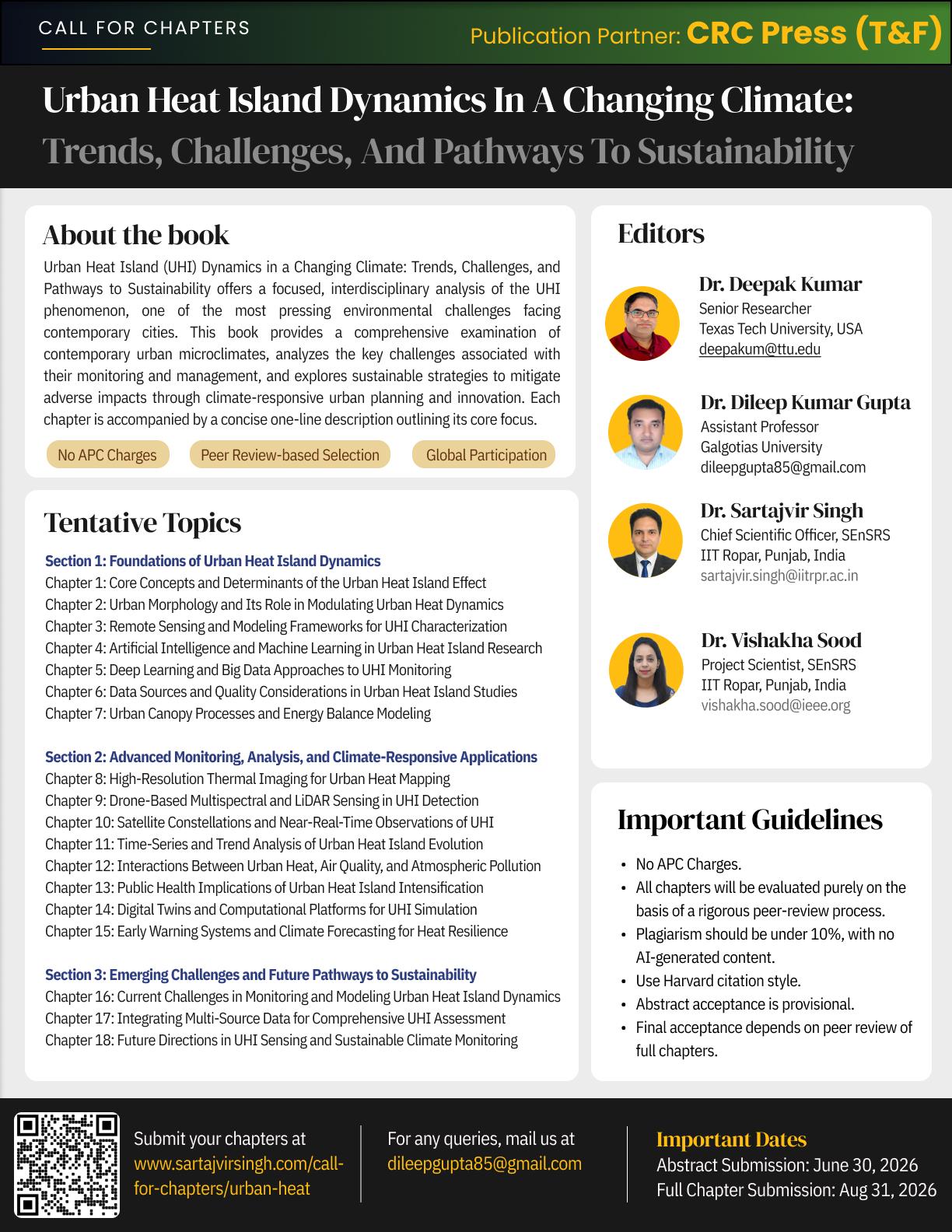
Urban Heat Island Dynamics in a Changing Climate: Trends, Challenges, and Pathways to Sustainability
Publisher: Taylor & Francis - CRC Press
Editors: Dileep Kumar Gupta, Sartajvir Singh, Vishakha Sood
Urban Heat Island (UHI) Dynamics in a Changing Climate: Trends, Challenges, and Pathways to Sustainability offers a focused, interdisciplinary analysis of the urban heat island phenomenon, one of the most pressing environmental challenges facing contemporary cities. The book provides a comprehensive examination of contemporary urban microclimates, analyzes the key challenges associated with their monitoring and management, and explores sustainable strategies to mitigate adverse impacts through climate-responsive urban planning and innovation. The volume covers foundational concepts, advanced monitoring technologies, artificial intelligence, remote sensing applications, public health implications, digital twins, early warning systems, and future pathways for sustainable urban climate management.
| Important Dates | |
|---|---|
| Abstract Submission Deadline | 30 June 2026 |
| Abstract Acceptance Notification | 15 July 2026 |
| Full Chapter Submission Deadline | 31 August 2023 |
| Chapter Acceptance Notification | 31 October 2026 |
| Projected Book Release Date | 2027 |
| Important Guidelines | |
|---|---|
| Indexing | Chapters will be sent for possible inclusion in Scopus and No APC Charges |
| Originality | Plagiarism should be under 10%, with no AI-generated content |
| Citation Style | Harvard |
Chapter 1: Core Concepts and Determinants of the Urban Heat Island Effect
Chapter 2: Urban Morphology and Its Role in Modulating Urban Heat Dynamics
Chapter 3: Remote Sensing and Modeling Frameworks for UHI Characterization
Chapter 4: Artificial Intelligence and Machine Learning in Urban Heat Island Research
Chapter 5: Deep Learning and Big Data Approaches to UHI Monitoring
Chapter 6: Data Sources and Quality Considerations in Urban Heat Island Studies
Chapter 7: Urban Canopy Processes and Energy Balance Modeling
Chapter 8: High-Resolution Thermal Imaging for Urban Heat Mapping
Chapter 9: Drone-Based Multispectral and LiDAR Sensing in UHI Detection
Chapter 10: Satellite Constellations and Near-Real-Time Observations of UHI
Chapter 11: Time-Series and Trend Analysis of Urban Heat Island Evolution
Chapter 12: Interactions Between Urban Heat, Air Quality, and Atmospheric Pollution
Chapter 13: Public Health Implications of Urban Heat Island Intensification
Chapter 14: Digital Twins and Computational Platforms for UHI Simulation
Chapter 15: Early Warning Systems and Climate Forecasting for Heat Resilience
Chapter 16: Current Challenges in Monitoring and Modeling Urban Heat Island Dynamics
Chapter 17: Integrating Multi-Source Data for Comprehensive UHI Assessment
Chapter 18: Future Directions in UHI Sensing and Sustainable Climate Monitoring
Showing all Related Products:



Need Help?
Book an Appointment for Expert Consultancy Schedule a session for Patent Filing, Design Registration or Research Guidance tailored to your needs.